Press and media
You’re Not Paranoid, You Just Work Here is Natasha Cecil’s first book. It names the unwritten rules of work, from quiet firing and the loyalty tax to groupthink and engagement theatre, says where each one comes from and sets out what a person can do when one is being used on them. This page holds what a journalist or a producer usually asks for. The paperback will open for pre-order ahead of its first print run, and the website is taking email addresses for that now.
- Title
- You’re Not Paranoid, You Just Work Here
- Subtitle
- The unwritten rules of work, and what to do when they’re used against you
- Author
- Natasha Cecil
- Format
- Paperback, 152 x 229mm; ebook and audiobook to follow
- Price
- £14.99 with UK postage, when pre-orders open
- Website
- yourenotparanoid.co.uk
What the book argues
Organisations build structures and incentives that produce the same patterns again and again, and no individual manager has to be plotting anything for that to happen. Most of those patterns have been studied for decades and have proper names, from tournament theory and the Peter principle to organisational silence and the redundancy spiral, but the research lives in academic journals and the terminology lives in HR departments and MBA courses. The people on the receiving end rarely see any of it.
The book gives them the names. Each chapter sets out one mechanism in plain English, who coined it and when, the signs you’re inside it and your practical options, which come down to using it, working around it or getting out. It is honest about which ideas are heavy academic theory, which are legal concepts and which are satirical observations that survive because they keep coming true. Legal content has been checked against current UK employment law guidance, and every concept is credited to its source in an index at the back.
About the author
Short
Natasha Cecil is a learning and organisational design consultant and the author of You’re Not Paranoid, You Just Work Here.
Longer
Natasha Cecil is a learning and organisational design consultant who has spent most of her career as a contractor moving between industries, from universities and the NHS to publishers and telecoms. The names on the building kept changing and the playbook stayed the same, which gave her a point of comparison that someone who spends a career inside one organisation rarely gets. She is the author of the DAD Framework for instructional design. Her second book, Vulturepreneur, is about the companies that earn more when your life gets worse.
The cover

The cover may be reproduced for coverage of the book. Please don’t crop it or change the colours.
- Download the cover (PNG, 1024 by 1536 pixels)
- Download the social sharing image (PNG, 1200 by 630 pixels)

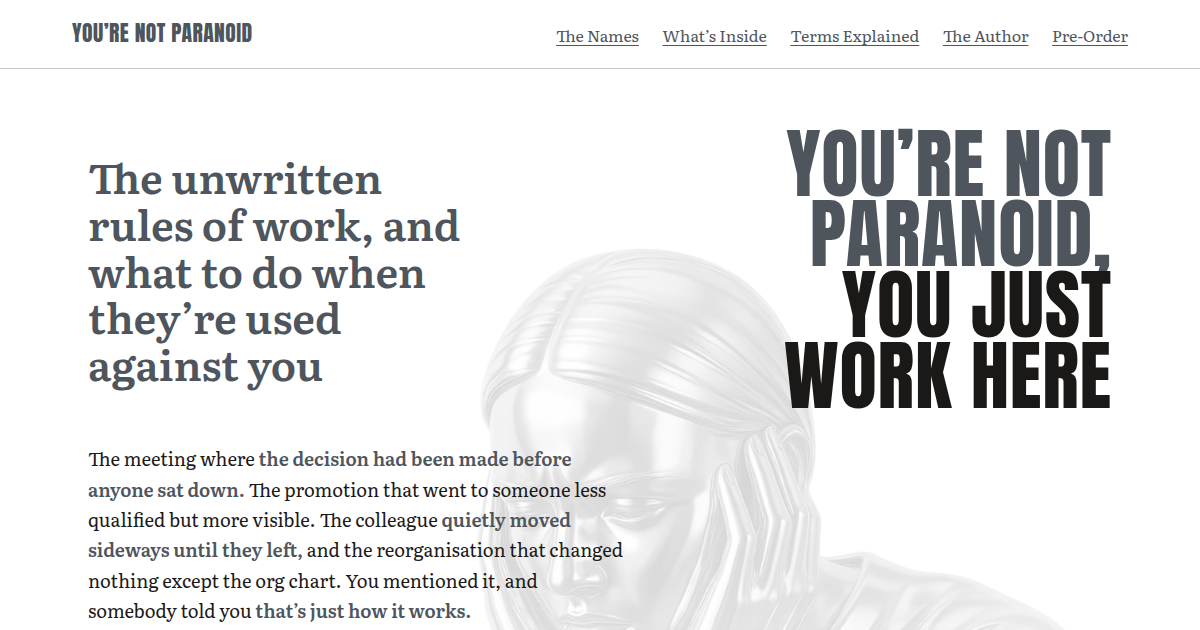
A print-resolution file is available on request through the form below.
Topics for interview or comment
Natasha can speak about any of the following, from the research behind the book.
- Quiet firing, PIPs as managed exits and constructive dismissal: how an exit gets engineered without anyone saying the words
- The loyalty tax, golden handcuffs and non-compete clauses: the mechanics that keep people where they are
- Engagement theatre and wellbeing washing: surveys, initiatives and working groups that change nothing
- Groupthink, pluralistic ignorance and organisational silence: why a room full of people who disagree still votes yes
- The Peter principle, tournament theory and stack ranking: who gets promoted and why
- Goodhart’s law at work: what happens when pay depends on a number
- The redundancy spiral: hiring freezes, restructures and cuts justified by AI
- Toxic handlers and effort-reward imbalance: the people who absorb a workplace’s distress and what it costs them
- Being neurodivergent at work, and why pattern-spotting made these mechanisms visible before they had names
Media enquiries
Interview requests, review copies when they exist, and questions about the research go through this form, and you’ll get a reply from Natasha herself.